Observing the Draconids Meteor Shower in Early October
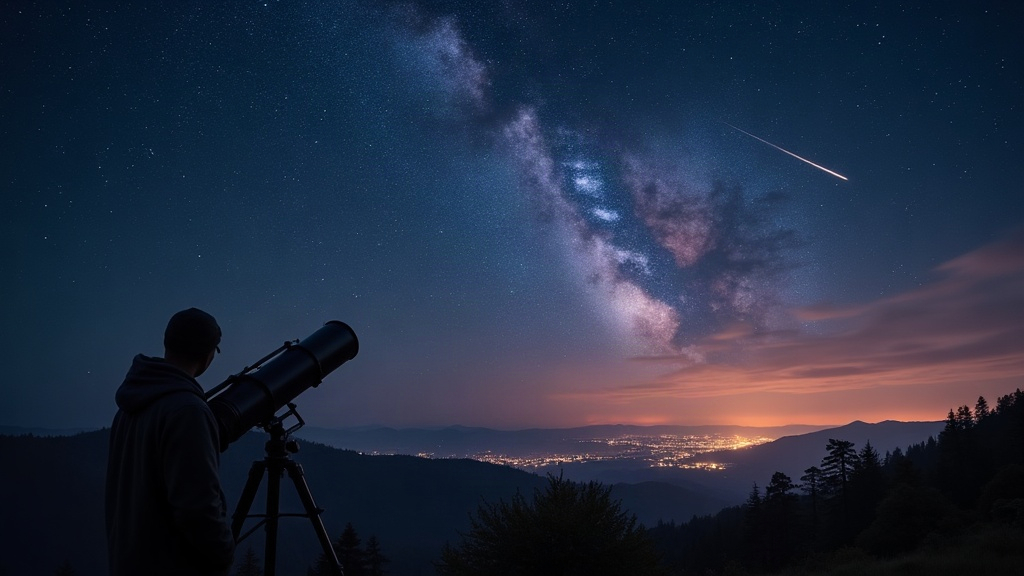
The Draconids meteor shower lights up the sky in early October, and it stands out for one simple reason: you don’t have to stay up past midnight to catch it. Most meteor showers demand a 2 a.m. alarm clock. This one doesn’t. That makes it a genuinely family-friendly event for skywatchers up north. Typical rates sit at a modest 10 to 20 meteors per hour, nothing to write home about on paper, but every so often the Draconids throw a curveball, producing outbursts with hundreds of meteors in a single hour. That history of surprise is exactly why it’s worth putting on your calendar year after year.
What Are the Draconids?
The Draconids, also known as the Giacobinids, come from debris shed by periodic comet 21P/Giacobini-Zinner. Each early October, Earth plows through the dusty trail this comet has left behind over its many orbits. Tiny particles, most no bigger than a grain of sand, slam into our atmosphere at high speed and burn up, leaving the streaks of light we call meteors. The shower takes its name from the radiant, the point in the sky where meteors appear to originate from, which sits near the head of Draco, the Dragon constellation.
When to Watch: Peak Dates and Times
Expect activity from October 6 through October 10, with the peak usually landing on the night of October 8-9. That said, don’t treat this as gospel. Check an updated meteor shower calendar close to the actual date, because the peak can shift by a day or so depending on the year.
Here’s the quirky part: most meteor showers reward pre-dawn patience, but the Draconids flip that script. They’re best seen in the early evening, shortly after nightfall. Why? Because Draco sits highest in the sky during evening hours for Northern Hemisphere observers, then gradually sinks as the night wears on. Sleep in if you want. Just don’t skip sunset.
Why Northern Latitudes Have the Advantage
For much of the Northern Hemisphere, Draco is circumpolar. That’s a fancy way of saying it never sets. If you’re in Canada, northern Europe, Russia, or the northern tier of the United States, the constellation stays visible all night long. That gives you a real edge over observers near the equator or down in the Southern Hemisphere, where Draco might barely peek above the horizon, or not show up at all.
How to Watch the Draconids
You don’t need a telescope, a star app subscription, or a fancy setup. Just some patience and the right conditions.
- Find dark skies: Get away from city lights if you can. Light pollution is the number one meteor killer, full stop. Even a 20-minute drive out of town can double or triple what you see.
- Check the moon phase: A bright moon washes out the fainter streaks. Look up the lunar calendar for the peak night before you plan your trip.
- Give your eyes time to adjust: Dark adaptation takes 20 to 30 minutes. Resist the urge to check your phone during this window, one glance at a bright screen and you’re starting the clock over.
- Look generally overhead, not just at Draco: Meteors can streak across any part of the sky. Trace the path backward, though, and it’ll point toward the radiant near Draco’s head.
- Dress warmly and get comfortable: Early October nights at northern latitudes can get surprisingly cold, think jacket-and-gloves weather. A reclining chair or a blanket spread on the ground beats craning your neck for an hour.
- No telescope needed: Honestly, skip it. Telescopes narrow your field of view way too much for meteor watching. Naked eye wins here.
Will This Year Be a Good Show?
The Draconids have a well-earned reputation for throwing surprises. Back in 1933 and 1946, observers witnessed full-blown meteor storms, thousands of meteors per hour, numbers that would make any skywatcher drop their coffee. More recently, 2011 and 2012 saw outbursts with rates spiking well above the usual 10-20 baseline. These flare-ups happen when Earth crosses an especially dense filament of cometary debris. Researchers studying the comet’s orbital history can sometimes flag these dense patches in advance, but it’s far from an exact science.
Given that unpredictability, it’s worth stepping outside even during a so-called “normal” year. You might only catch a handful of meteors trickling by. Or you might stumble onto something memorable. There’s really no way to know for sure until you look up.
Tips for Photographing the Draconids
Want to bring home some images instead of just memories?
- Use a camera with manual controls (DSLR or mirrorless will do)
- Go wide-angle, open the aperture up to f/2.8 or lower, and set ISO somewhere between 1600 and 3200
- Keep exposures to 10-15 seconds so stars don’t trail into streaks
- Lock your camera onto a sturdy tripod and fire the shutter remotely or with a timer, touching the camera during a long exposure will blur everything
Conclusion
The Draconids hand you something rare: a meteor shower you can actually watch at a reasonable hour, especially rewarding if you’re far enough north that Draco barely dips toward the horizon. Sure, most years deliver a modest trickle rather than a storm. But given the shower’s track record of surprise outbursts, every early October sky deserves at least a glance. Grab a blanket, find somewhere dark, let your eyes adjust, and wait. You never know, this could be the year the Dragon puts on a show worth telling people about for years.