Why Saturn's Hexagonal Storm Hasn't Dissipated in 40 Years
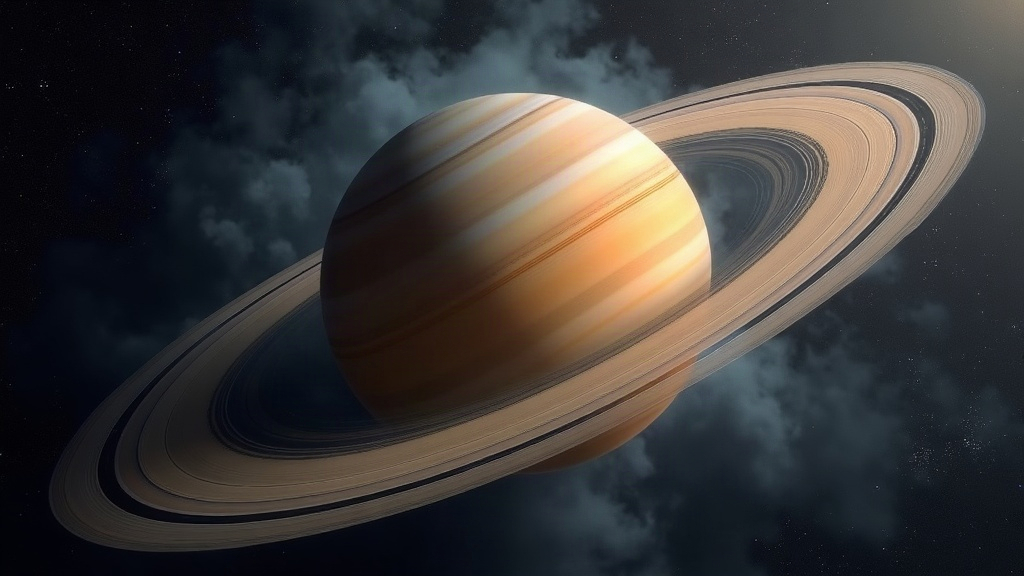
Why Saturn’s Hexagonal Storm Hasn’t Dissipated in 40 Years
Saturn’s hexagon is one of those cosmic oddities that just refuses to make sense at first glance. Voyager caught the first images of it back in 1980-81, and when Cassini rolled up more than thirty years later, the six-sided jet stream circling the north pole looked… basically identical. Same shape, same spot. The explanation turns out to be almost anticlimactic once you hear it: it was never a storm to begin with. What we’re looking at is a standing wave locked inside a deep, screaming-fast jet stream, on a planet that has no ground, no coastline, nothing to snag it and tear it apart.
What Saturn’s Hexagon Actually Is
Forget the name for a second. This isn’t a hurricane, and it doesn’t behave like one. It’s a jet stream, a ribbon of wind tearing around the north pole at roughly 320 km/h (about 200 mph). And the scale is almost hard to picture: about 20,000 miles (32,000 km) across. You could line up more than two Earths side by side inside it and still have room to spare.
Tucked inside the hexagon is a churning polar vortex, and right at the center sits a giant hurricane-like eye, something like 50 times the size of an average Earth hurricane. The six flat edges we see from space mark where this outer jet bends and folds into a repeating geometric pattern rather than a smooth circle.
Why a Hexagon? The Physics of Rotating Fluids
Sounds like something engineered, doesn’t it? But no, it’s just fluid dynamics doing its thing. When a fast jet stream moves through a rotating fluid, tiny disturbances can amplify into standing waves, waves that hold their position instead of drifting around. Get exactly six of these waves to fit neatly around the pole, and boom, you’ve got a stable six-sided shape.
This isn’t just theory either. Back in 2010, a team at Oxford University spun water in a rotating tank in the lab and watched it settle into hexagons and other polygon shapes on its own. That experiment proved Saturn isn’t special here; any time a fast inner jet grinds against a slower outer flow in a rotating system, you can get this kind of geometry. The number of sides just depends on how big the speed gap is between the two currents.
Three Reasons It Hasn’t Dissipated
A few things line up perfectly to keep this hexagon alive for decades on end.
- No solid surface: On Earth, storms slam into mountain ranges, coastlines, and plain old ground friction, and that wears them down fast. Saturn has none of that. It’s a gas giant through and through, so there’s nothing physical to slow the jet or knock the wave pattern off balance.
- Stable rotation and low turbulence: The polar region where the hexagon lives is unusually calm, almost undisturbed. Once that six-wave pattern clicks into place, it basically reinforces itself, like a rut that gets deeper the longer a wheel rolls through it.
- Deep roots: During Cassini’s 2017 “Grand Finale” dives, gravity measurements showed the hexagon isn’t just a surface feature. It reaches down into the atmosphere, possibly thousands of kilometers. Something rooted that deep just isn’t going to get knocked over by anything happening near the cloud tops.
Put simply, the hexagon isn’t clinging on against the odds. It’s sitting in equilibrium. As long as Saturn keeps spinning at roughly the same rate and that jet stream keeps flowing, the shape has no reason to change.
Was It Really the Same Hexagon After 30 Years?
Pretty much, yes. Line up the Voyager images from 1980-81 next to Cassini’s shots from 2006 onward, and you’re looking at the same six-sided pattern, sitting at the same latitude. Cassini even tracked it as it emerged from decades of polar night into sunlight, and the geometry hadn’t budged.
There was one real change worth mentioning, though. Between 2012 and 2016, the hexagon’s color shifted from a turquoise blue to a warmer, golden tone. Researchers think this came down to increased sunlight generating hydrocarbon haze particles as Saturn’s northern hemisphere moved into summer, not any weakening of the underlying jet stream. So the paint job changed. The structure underneath didn’t.
What the Hexagon Teaches Us
Saturn’s hexagon works almost like a natural laboratory sitting a billion kilometers away, letting us study how jet streams, waves, and vortices behave on worlds we’ll never set foot on. The math behind it, mostly Rossby waves and general rotating-fluid dynamics, also shows up when scientists model Earth’s polar jet streams, Jupiter’s banded clouds, and even large-scale ocean currents back home.
It’s also a good reminder that “weather” doesn’t run on the same clock everywhere. A storm on Earth might last a few days, maybe a couple of weeks if it’s stubborn. On Saturn, the same kind of feature can run for decades, centuries, who knows, maybe longer than that.
Conclusion
So why hasn’t Saturn’s hexagonal storm dissipated in 40 years? Because it was never a storm in the first place. It’s a stable, deeply anchored standing wave riding inside a fast polar jet stream, on a planet with zero surface friction to break it up. Voyager spotted it in 1980, Cassini confirmed it was still there decades on, and lab experiments right here on Earth have recreated the same shape in a spinning tank of water. Barring some dramatic shift in Saturn’s rotation or its atmospheric circulation, this six-sided oddity is probably going to be waiting there, patient as ever, for whatever spacecraft we send next.