Spotting Andromeda Galaxy's Dust Lanes with a 12-Inch Dobsonian
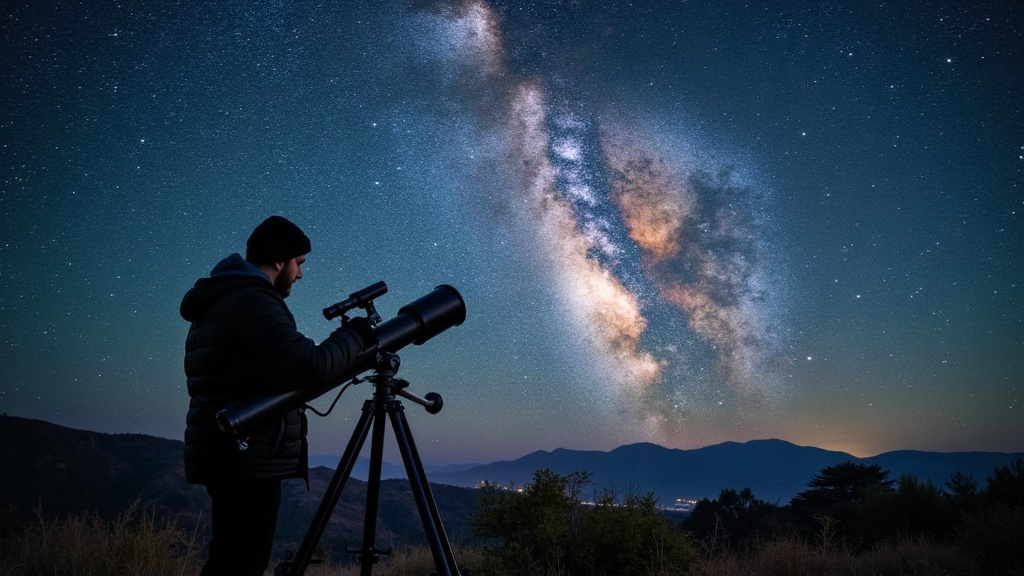
Spotting the Andromeda Galaxy’s dust lanes through a 12-inch Dobsonian ranks among the most satisfying visual challenges you can take on as an amateur. And yes, you can actually pull it off without a camera. Get the sky conditions right, pick the correct eyepiece, apply a bit of technique, and that faint mottled texture crossing M31’s disk stops being a rumor passed around astronomy forums. It becomes something you can genuinely see at the eyepiece.
Why Dust Lanes Are So Hard to See
M31 is big. Really big, spanning more than 3 degrees of sky, wider than six full moons laid side by side. But its dust lanes are a different story: low-contrast features buried inside a glow that’s already diffuse to begin with. Stars are easy because they’re point sources. Dust lanes aren’t. They’re extended, low-surface-brightness structures, which makes them brutally sensitive to things like:
- Sky darkness (Bortle 1-3 skies make a massive difference)
- Transparency (haze or high humidity kills contrast fast)
- Dark adaptation (minimum 30-45 minutes, and no, don’t check your phone)
- Aperture and magnification (more light-gathering means more structure pulled out of the noise)
A 12-inch Dobsonian collects roughly four times the light of a typical 6-inch scope. That’s precisely the jump needed to start resolving the darker dust bands, especially the prominent one sitting just northwest of the nucleus.
Best Conditions for the Attempt
Timing counts for just as much as the gear you bring. Aim for:
- New moon week, ideally with the moon fully below the horizon
- Autumn months (September through November in the Northern Hemisphere), when Andromeda sits high overhead around midnight
- Transparency over seeing. Unlike planetary work, hunting a galaxy’s faint structure cares less about steady air and more about a clear, dry, dust-free atmosphere
- Altitude above 50° to cut down atmospheric extinction
Rural or high-elevation dark-sky sites will crush suburban backyards on this target, no contest. If your limiting magnitude sits below 6.0, detecting dust lanes gets extremely tough even with a full foot of aperture pointed at the sky.
Eyepiece and Magnification Strategy
Here’s the part that trips people up: low power usually wins for extended, diffuse structure like this.
- Start with a wide-field eyepiece around 30-40mm (roughly 35-50x) so you can frame the whole galaxy plus the dark sky around it
- Use averted vision. Look slightly off to the side of the nucleus rather than straight at it, which engages the rod cells in your eye that do the heavy lifting in dim light
- Try a UHC or broadband nebula filter now and then, but don’t expect much. Dust lanes aren’t emission nebulae, so filters do far less work here than they do on planetary nebulae. The real contrast boost comes from dark skies, not glass in your eyepiece
- Once you’ve roughly located the dust lane region, push up to moderate power (80-120x) to isolate it against the background sky
What You’ll Actually See
Forget the idea of a photographic negative floating in your eyepiece. Under excellent skies through a 12-inch Dob, dust lanes usually show up as:
- A subtle darkening, almost a mottling, across the southeastern disk between the nucleus and the galaxy’s edge
- Slightly easier to catch near NGC 206, the bright star cloud that makes a handy reference point
- More obvious with slow, patient scanning than a quick glance. Give your eye 20-30 seconds per view to build up the image
Experienced observers often call it “a texture” rather than a defined line. Think brushstrokes in an oil painting versus a hard pencil mark. That’s roughly the distinction.
Practical Tips for Success
- Cool your telescope completely before you start. Thermal currents still swirling inside the tube will wreck your contrast
- Use a dew shield to block stray light and keep dew off the secondary mirror
- Observe for at least an hour, coming back to the galaxy repeatedly as your eyes keep adapting
- Sketch what you see. Forcing yourself to record detail on paper separates real detections from things your brain just wants to see
- Compare against photos afterward, never before, so you’re not unconsciously chasing what you already expect
Conclusion
Catching Andromeda’s dust lanes with a 12-inch Dobsonian isn’t a matter of aperture alone. It’s dark skies, patience, and smart eyepiece choices working together. Pick a clear, moonless autumn night, let the scope cool properly, commit to at least 45 minutes at the eyepiece, and work the averted vision patiently rather than rushing it. What you get in return is a direct, unfiltered visual link to the vast, dusty spiral arms of our nearest big galactic neighbor. No camera, no processing software, just your eye and two million light-years of distance.